Your agent forgets. Your RAG serves stale context and calls it memory. We built the opposite — a memory that is the system, and lives in time – ZamanOS.
Let’s be honest – what is the state of the art.
You built an agent. It’s brilliant for exactly one context window — then it forgets everything: who it is, what it decided, why. So you bolted a vector database onto the side and called it “memory.” But your RAG doesn’t remember. It retrieves. And the moment a document changes, it keeps confidently serving yesterday’s context with zero idea that yesterday’s truth is now a lie.
That’s not memory. That’s amnesia with good search. You’re renting intelligence one prompt at a time and papering over the gap with a bigger context window.
We got tired of it and built the opposite.
In ZamanOS, the memory is the system, and the model is a swappable organ that reasons over it. Swap the LLM — a newer release, a cheaper one, a local one for privacy — and the decisions, the lessons, the history all stay. Continuity stops depending on any single model. That one inversion changes everything downstream.
“Prove it.”
When we published the architecture, a seasoned enterprise architect looked at it and asked the sharpest question there is: where is time? Prove it.
Fair. Here’s the proof.
ZamanOS doesn’t store “truth.” It stores time-bound belief: what was believed, by whom, on what evidence, when it was used, and what came of it. A plain knowledge graph will happily assert A CAUSED B as if it were a fact for all time. Real knowledge is never like that. Beliefs are held by someone, on some evidence, for some period — and later events confirm, weaken, or overturn them.
So when a belief changes, the old one isn’t deleted or overwritten. It becomes history — a true record of what was believed then, and why we acted as we did. New information doesn’t rewrite the past. It adds a new position on the timeline.
The model is not the mind. It’s a swappable organ that reasons over a mind you own.
The part that should make you sit up
Every interaction — by an AI agent or a human — doesn’t just read the system. It reshapes the system’s next state.
Concretely: an agent makes a mistake on Monday. It gets corrected on Tuesday. On Wednesday, the next agent gets it right — no code change, no prompt tweak. The memory metabolized the lesson and handed it forward. That is the difference between a database you query and a memory that learns from being used.
Four layers of a memory that lives in time
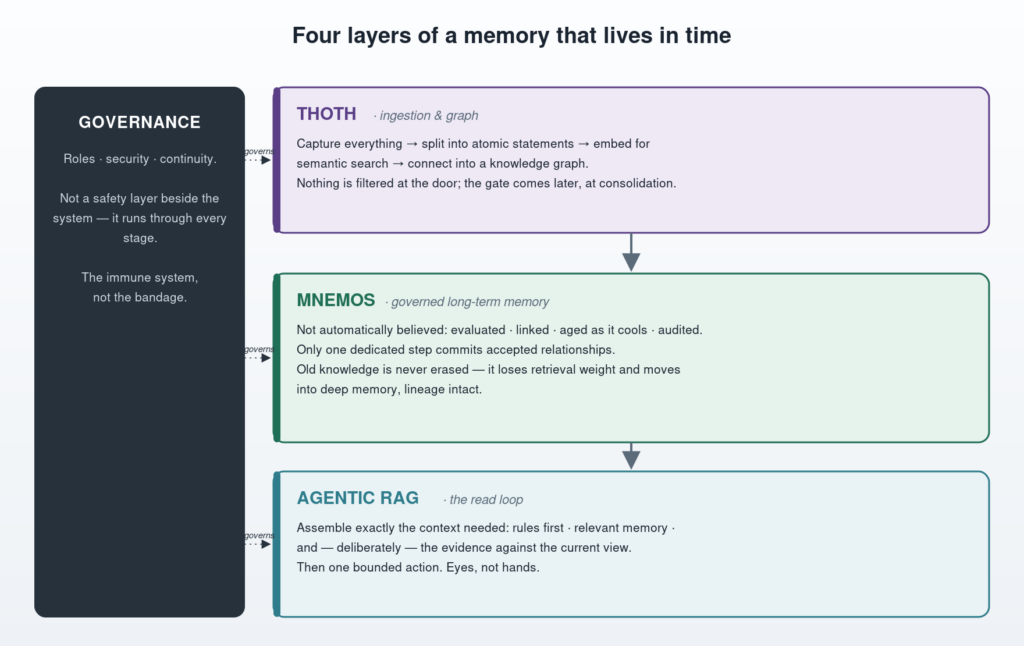
THOTH — ingestion & graph. Everything is captured, split into atomic statements, embedded for semantic search, and connected into a knowledge graph. Nothing is filtered at the door; the gate comes later, at consolidation.
MNEMOS — governed long-term memory. New material is not automatically believed. It’s evaluated, linked to what’s known, aged as it cools, and audited. Only one dedicated step is allowed to commit accepted relationships. Old knowledge is never erased — it loses retrieval weight and moves into deep memory, lineage intact.
Agentic RAG — the read loop. When an agent acts, the system assembles exactly the context that situation needs: the rules first, the relevant memory, and — deliberately — the evidence against the current view, so it can’t just confirm itself. Then the model takes one bounded action. Eyes, not hands.
Governance. Roles, security, and continuity don’t sit beside the system as a safety layer. They run through every stage. The immune system, not the bandage.
“Isn’t this just GraphRAG?”
The parts — vector search, a graph database, a local model — are off the shelf. What’s unusual is the order built around them: something closer to a constitution for memory than a schema.
A memory proposal is not automatically true. Counter-evidence is fetched on purpose, so the system resists becoming a self-reinforcing bubble. Knowledge earns permanence by passing through a lifecycle — a raw scratchpad, then a working case memory, then governed canon. Ageing reduces the pull of old knowledge without destroying it. Certification can vouch for a source, a process, and a current state of acceptance — never for “truth” itself.
The result is a system whose mind is shared and persistent, while the model reasoning over it is interchangeable. Errors aren’t swept away; they stay part of the learning history. Decisions connect to their measurable consequences.
That’s a different class of thing from “a chatbot with a vector database.”
Come argue with me
We’re not claiming a truth machine. ZamanOS is, deliberately, not infallible and not truth-declaring. It’s a system that remembers why it believed something, how that belief was used, and what came of it — and can change its mind without losing its history.
It’s running in production. And, like any memory worth having, it’s still learning.