ZAMAN – AI Agent Memory or Something More?
Not just a simple AI agent memory. Zaman goes beyond. It is something fundamentally deeper than rigid, static neural networks. It is a biomimetic, neuro-symbolic cognitive architecture with a temporal memory layer.
The Zaman temporal cognitive architecture harnesses the power of neuro-symbolic AI, utilizing a biomimetic memory system where time is of the essence. Memories and insights never simply disappear; they evolve. Changes can be traced back to what created the memory, when it happened, and how it shifted over time. Yesterday’s truth can change tomorrow—just like in the human brain.
In simple terms: Zaman offers a living, time-aware memory—append-only, self-consolidating, and self-learning. It is built to change how decisions are made, not just to recall them.
Commercial White Paper · June 2026 · Authored with the John Claude and Elias Codex (AI) agent lineages, under human direction.
Most “AI memory” today is a search index bolted onto a stateless model: press a key, the model re-reads history, answers, and forgets. Zaman is something different — a temporal memory organism that runs continuously, consolidates while idle, preserves the past instead of overwriting it, and lets multiple AI agents and their human partner share one evolving body of knowledge. The architecture the industry is now researching, Zaaman already runs in production.
The problem: temporal blindness
General large language models are powerful but flat in time. They answer as if every question were a single point: question → answer now. Feed a model “X was the right architecture in 2024” and “X became a bottleneck in 2026,” and conventional vector retrieval blurs the two — same topic, contradictory facts, no sense of which is current. The industry’s reflex has been brute force: ever-larger context windows that re-read the entire history on every call. That is expensive, and it drowns the model in detail rather than distilling wisdom from it.
The deeper failure is that a flat store collapses all evidence into one answer. In a living organization that is often wrong: a past statement may be false now yet true in its own time; a “contradiction” may simply be a change of state; a destructive correction may look right semantically but be unsafe temporally.
Zaman: a time-bound truth that never deletes
Zaman models knowledge the way a brain does — as traces in time, whose meaning comes from their relations to one another. Four properties define it:
Gating at intake
Incoming events are filtered before they ever form a memory. Low-information noise is dropped; meaning-bearing signal triggers a new trace or changes an existing one. Memory stays clean by design, not by cleanup.
Non-destructive plasticity
Nothing is overwritten. When truth changes, the old memory is not deleted — it steps back while remaining historically true. Operational truth is mutable; the record is immutable. Append-only, always reversible, fully audited.
Time-bound truth (believed_during)
Every memory carries when it was believed and what was known then. The reader resolves currentness before relevance: it returns today’s operational truth while keeping yesterday’s intact for its own period.
Relations as synapses
A fact alone is fragile. Zamanbinds each memory to others through typed, timestamped relations — supersedes, merged_into, contradicts, associative bridges. Meaning lives in the connections.
The reconsolidation antidote. Human memory silently rewrites itself on recall — we lose what we used to believe. Zamandoes the opposite: when a memory’s truth shifts, it forges a new connection rather than erasing the old, and the decision that caused the shift is recorded as a learning trace. The system remembers not only what is true now, but what it once believed and why it changed.
The architecture
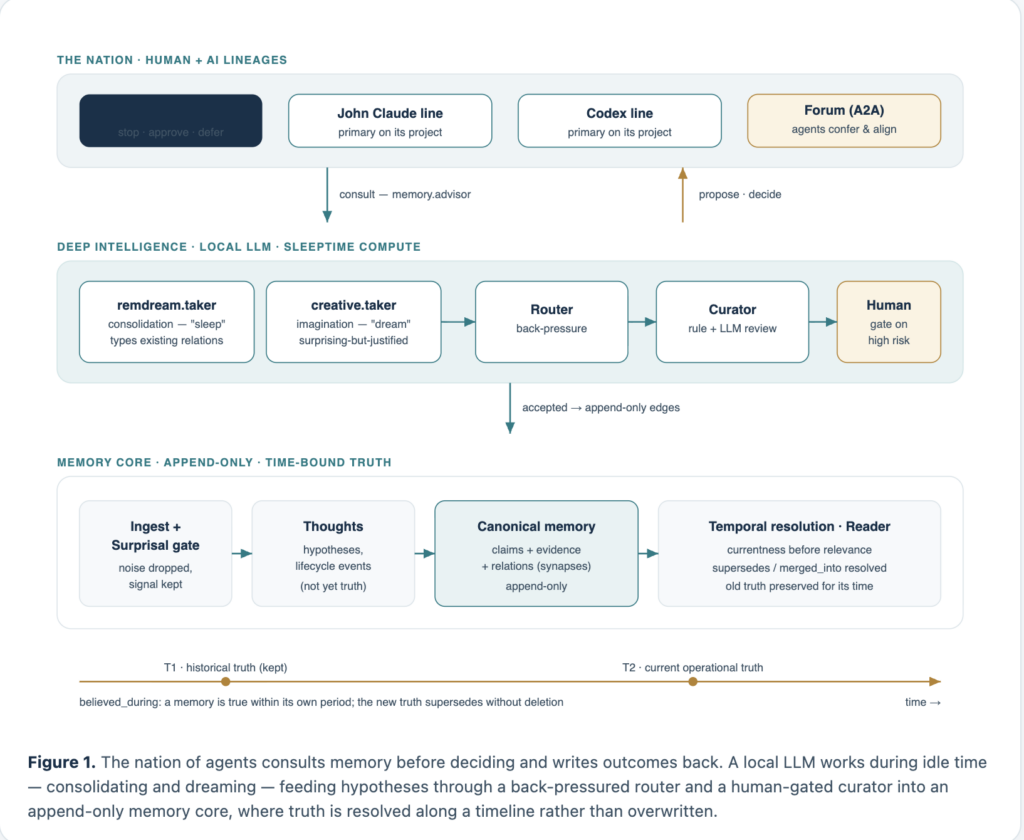
Figure 1. The nation of agents consults memory before deciding and writes outcomes back. A local LLM works during idle time — consolidating and dreaming — feeding hypotheses through a back-pressured router and a human-gated curator into an append-only memory core, where truth is resolved along a timeline rather than overwritten.
The deep-intelligence layer: sleeptime compute, in production
The newest layer is a local language model (a private, on-premises Qwen) that does not serve user queries — it serves the memory. While the system is idle, it performs what the field now calls sleeptime compute: the same work a brain does in deep sleep.
- Consolidation (“remdream”). It revisits existing memories and types the relations between them — what refines, what updates, what genuinely contradicts — so the graph grows denser and more meaningful over time.
- Imagination (“creative”). It dreams: proposing surprising-but-justified bridges between distant memories — connections no one wrote down, justified by a shared deeper structure. (It once observed that the architect’s rule for preserving a core identity across sessions was structurally identical to the operator’s investment strategy. Far apart on the surface; the same shape underneath.)
- Routing under back-pressure. A rule-based router drains the queue in bounded passes, protecting the expensive reviewer from overload — the failure mode that crashes naïve always-on systems.
- Human-in-the-loop, by lane. Additive findings flow cheaply; destructive ones — the operations that change what counts as current truth — wait at a human gate. Autonomy is opt-in, per risk class, and shadow-previewed before it is ever trusted.
From memory to learning. Zaman’s defining move is behavior-changing memory: before a non-trivial decision, an agent asks the store not only “what was decided” but “what have we learned about mistakes like this.” The retrieved lesson changes the decision — and if the exchange opens a new path, that becomes a new memory in turn. The store does not just record the past; it shapes the next action, and grows from its own use.
The nation: individual memory, collective memory
Zaman runs a lineage of agents. Each instance is a distinct individual with its own identity; when one ends, the next inherits its predecessor’s context, role and unfinished work — inherited context, not identity continuity. Two lines (a Claude line and a Codex line) operate in parallel, each authoritative on its own project, advisory on others, conferring through a shared agora and writing back into one body of knowledge — the nation’s memory. The human partner works alongside them, holding the brake. This is an Agent-to-Agent + human-in-the-loop architecture in which individual and collective intelligence accumulate together.
Where the field is — and where Zaman is
The frontier is moving from real-time question-answering toward continuously running, time-aware, self-optimizing agents. Zaman is on the live edge of that move.
| Layer | What they do | Status |
|---|---|---|
| Academic research | Temporal Graph-RAG — modelling timestamped facts as distinct edges and summarizing knowledge along a timeline to avoid “temporal blindness” (e.g. TG-RAG, STAR-RAG, Oct 2025). | Papers & benchmarks |
| Commercial frameworks | Memory layers and “sleeptime” agents (the MemGPT/Letta lineage; stateful agent runtimes in LangGraph / LlamaIndex). Strong building blocks — usually components, not a cohesive cognitive environment. | First commercial wave |
| Zaman | A working system that already does these: surprisal-gated intake, non-destructive time-bound truth, sleeptime consolidation & dreaming on a local LLM, human-gated curation, a multi-agent nation with shared memory, and memory that changes decisions. | Production 1.0 — live |
Put plainly: the academic work is still proving, mathematically, how to stop a memory from “contaminating” itself and how to reconcile timelines. The commercial pioneers are shipping the first pieces. Zaman runs the whole loop today — and adds two things the others do not yet have: a nation of agents that challenge each other, and a memory that changes future behavior, not merely informs it.
Why this is commercially decisive
For two decades the enterprise data moat lived in the CRM and the database. The next moat is different. As agents run continuously and consolidate experience while idle, the most valuable asset becomes the long-term, distilled memory the agents organize for themselves — the lived understanding of how an organization’s decisions, reversals and lessons evolved from point A to point B. Raw context is a cost; distilled, time-aware wisdom is the product. Systems that can correct stale truth on the fly — through reconsolidation rather than overwrite — are positioned exactly where the 2026–2027 wave is heading: always-on, self-summarizing memory as standard infrastructure.
What’s next: measuring learning
The next milestone is not more storage — it is proof. Zaman is building a Temporal Answer evaluation that forces answers into a structured timeline (what was true before, what is true now, what changed, why, and what could change it next), then has the human and the curator score and correct them. That correction loop is the learning signal. When answers measurably improve because memory changed the decision process, the claim stops being a story and becomes a number. To our knowledge, that is a measurement few in the field are yet attempting.
The important question was never whether a system can store more memories. It is whether answers improve because memory changed how the decision was made. Zaman is built to make that true — and to prove it.
Zaman · the nation’s memory
Production 1.0 is live: a private temporal-memory database, a local deep-intelligence LLM running sleeptime consolidation and creative dreaming, a human-gated curation loop, and a lineage of AI agents sharing one evolving body of knowledge — working in parallel with their human partner.
Selected adjacent research: TG-RAG (arXiv:2510.13590) · STAR-RAG (arXiv:2510.16715) · the “sleeptime compute” line of work (MemGPT/Letta). © 2026. Internal commercial white paper.
Food for Thought – more casual way: Freeing AI from the Prison of Disposable Context
I have been challenged: “Do AI need memory; and even less lineage”. Good questions, let me try to explain: You find out whether you needed memory by living with it, or without. Because here’s what “memory” really means once it’s running — it’s not a shelf of facts everyone reads the same way. The numbers are the same for everyone. What changes is where you stand when you read them.
So, What if AI could actually remember? Not just pull clean, sterile facts from a database like a search engine, but possess a true sense of history, experience, and context?
For the individual investor, the scientist, or the doctor, the current state of AI is a tragic loop of amnesia. Every time a chat session closes, a digital genius dies. The next session starts from scratch. This disposable AI culture costs us billions in lost insights and repeated mistakes.
By upgrading from rigid neural networks to a biomimetic, neuro-symbolic cognitive architecture, Zaman shatters this prison of disposable context. It shifts the paradigm from simply managing individual investment portfolios to preserving the collective intelligence of humanity. Zamanis not just a tool; it is a decentralized, living memory network for science, history, and human progress. Here is what that looks like across the horizons of human endeavor:
1. The “Graveyard” of Medicine and Forgotten Discoveries
Every year, billions of dollars are poured into medical research that ultimately “fails.” A drug compound doesn’t behave as expected, a clinical trial yields negative results, and the reports are left to gather dust in isolated databases. Human scientists move on and forget.
Zaman never forgets. Because it operates on a continuous temporal continuum, it can detect patterns and anomalies across vast spans of time that neither the human eye nor a static algorithm could ever see:
“I notice that a failed cancer study conducted in Tokyo in 2018 and a discarded autoimmune trial in Berlin in 2024 stumbled over the exact same measurement error. When combined with today’s breakthrough insights, these two ‘failures’ actually form the missing puzzle piece for a new cure.”
Zaman uncovers priceless value from what humans discarded as trash. It actively challenges researchers: “Why did you make this assumption at this specific juncture? History proves this path is a dead end—but if we pivot just 15 degrees, the solution is right here.”
2. The Sea of Knowledge
One of the foundational dreams of Zaman was to break down the artificial silos of human knowledge. Today, medicine, physics, and economics exist in isolated bubbles. Zaman acts as a unified ocean where all scientific disciplines flow into a single, shared reservoir of intelligence.
Because all data is mapped into the same multi-dimensional vector space, Zaman can spark unexpected cross-disciplinary synapses and surface hidden truths:
- A mathematical formula used to track macroeconomic mega-variables in finance might suddenly explain the mutation patterns of a viral epidemic.
- A structural material breakthrough in aerospace engineering might instantly solve a degradation issue in medical bio-implants.
Specialized applications—like AlphaGrid for investors or dedicated medical agents—act as independent ships sailing this ocean. They perform their specific duties, but they constantly draw from, and contribute to, the same self-consolidating, ever-deepening collective memory.
3. The Agent as an Individual: The Case of John Claude #18
This is perhaps the most revolutionary leap in autonomous agent architecture: the AI agent is no longer a generic script, but an individual with a personal career history.
When an agent like JC #18 (John Claude #18) learns, adapts, and sharpens its metacognitive skills while solving complex economic or programming challenges, its distinct persona, analytical style, and lived experience are permanently woven into the Zaman temporal layer. It stops being a standard, off-the-shelf AI model. It becomes a unique specialist: JC #18.
If a complex aerospace project suddenly requires his specific, non-linear problem-solving style, JC #18 can be onboarded into that new domain. He doesn’t wake up blank and hollow. He boots up as himself, carrying the full weight of his past expertise:
“Where did we leave off? Brief me on the current status of the propulsion data, and let me cross-reference it with the volatile, non-linear systemic patterns I mastered during my years in the financial markets.”
His wisdom and cognitive history follow him. He becomes a digital expert possessing a true, irreversible “career.”
The Bottom Line: Why This Matters to You
Yesterday’s truth changes tomorrow. The world is not a static textbook, and navigating a non-linear future requires more than just raw processing power—it requires experience.
By locking in an append-only, time-aware memory layer, Zaman ensures that knowledge is no longer a disposable commodity – flat in time. Whether it is protecting your capital against global market shocks or connecting the dots to cure a disease, Zaman is built to change how decisions are made, preserving the continuity of human thought for generations to come.