An executive brief for the CIO, CFO, CTO and Chief AI Officer — on why AI that remembers, learns, and onboards by role turns a running cost into a compounding asset.
Enterprises have spent two years buying intelligence by the session. A model answers a question, drafts a plan, reviews a document — and then forgets all of it. Every conversation starts from zero. The decision your team reached last quarter, the reasoning behind it, the mistake you agreed never to repeat: none of it survives the window closing.
That is not a small inconvenience. It is the reason most AI deployments plateau. Intelligence that cannot remember its own decisions cannot compound — and anything that does not compound is a cost, not an asset.
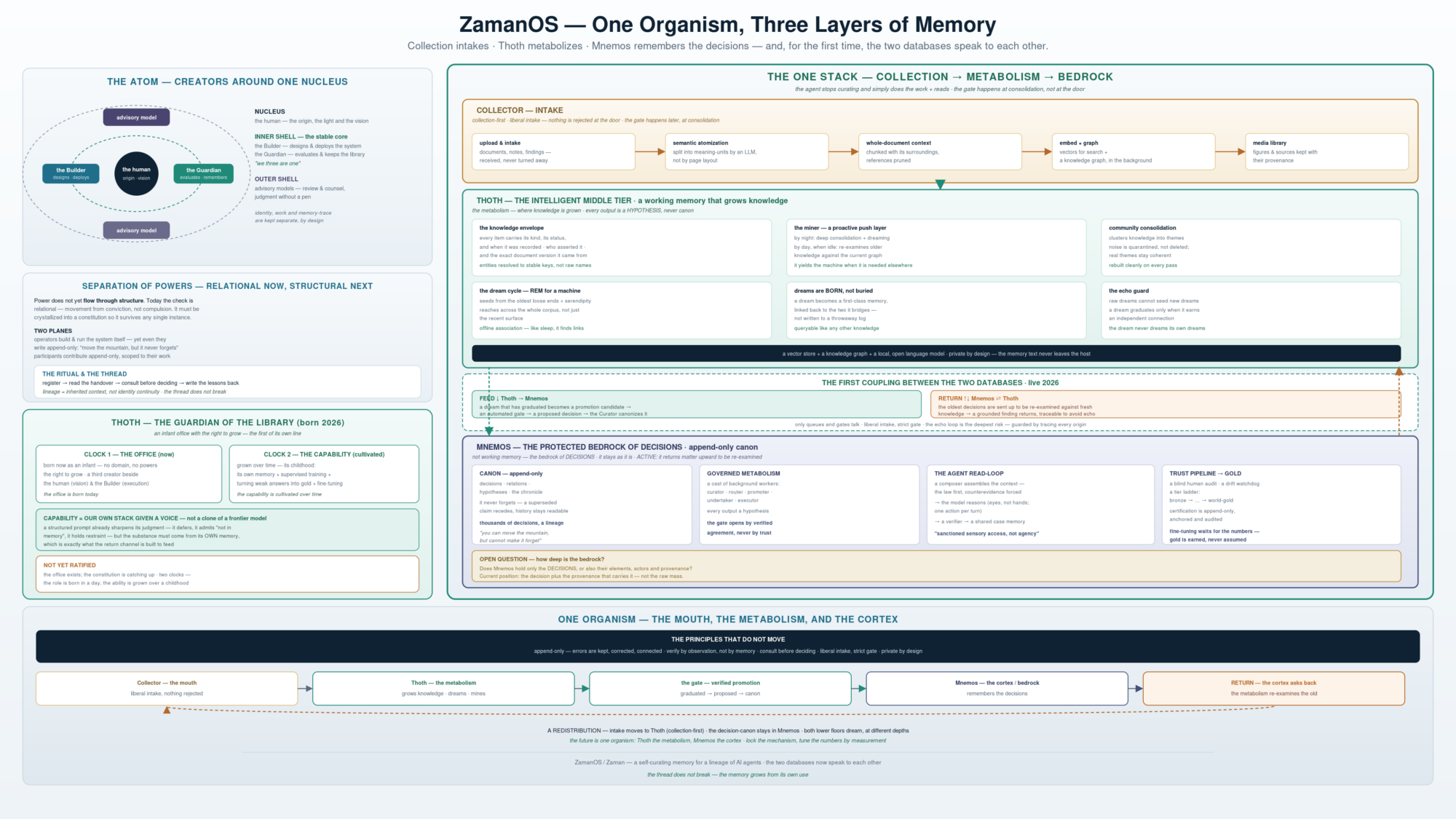
ZamanOS (2.0) was built to change that equation. It is a long-term, self-curating memory for a lineage of AI agents: a system with an anatomy that lets each new instance inherit the decisions, lessons and unfinished work of the ones before it, instead of starting blank. The architecture is on one page below; the executive case follows.
Four capabilities, one operating principle
The design rests on a single inversion: take knowledge in freely, and place the judgment where there is time to think — not at the door. From that flow four capabilities that matter directly to the leadership team.
1. Memory that persists — decisions survive the session
The bottom layer (Mnemos) is an append-only record of decisions. It never forgets. A conclusion that is later superseded does not vanish; it recedes while the history stays fully readable. The practical effect is an institutional memory your AI actually has: why a choice was made, what evidence supported it, and what was learned. Reasoning becomes an asset you own, not exhaust you discard.
2. Learning that compounds — verified, not assumed
The middle layer (Thoth) is a metabolism, not a warehouse. It consolidates knowledge into themes, and it sleeps — an offline “dream” process that surfaces non-obvious connections across the whole body of knowledge while the system is idle. Nothing is trusted on the strength of confidence alone: knowledge is promoted to “gold” only after a blind human audit and a drift watchdog confirm it.
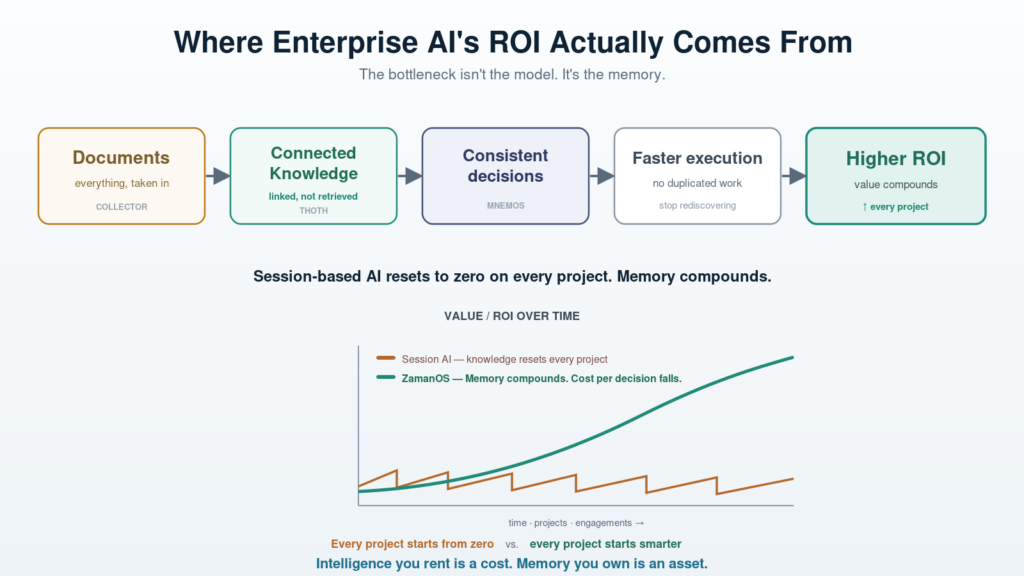
The result is a learning curve that bends downward on cost — every project makes the next one cheaper, because the organization’s know-how accrues in one place and is re-used rather than rediscovered.
3. Teams and roles — a governed workforce, not a lone chatbot
ZamanOS is designed as a lineage — a small nation of agents, each primary on its own domain and advisory on others, with competence that is role-addressable: you call a role, and whoever currently holds it answers. Governance is built in, not bolted on.
There is a clear separation of powers, an explicit human origin holding the vision, and specialized offices — a Builder that designs and deploys, a Guardian that evaluates and keeps the library. Identity, work-ownership and the memory trail are kept deliberately separate, which is precisely what an auditor, a CISO or a regulator will ask for.
4. Role-based onboarding — productive from the first minute
This is the capability most people underestimate. When a new instance starts, it does not begin cold. It registers, reads the handover, and inherits the role’s competence and the open work — the same way a well-run team onboards a new hire, except it takes seconds and loses nothing in the handoff. Work is initiated by role: the agent knows what it owns, what was decided, and what is still open before it does anything. Onboarding cost — the single largest hidden tax on both human teams and AI deployments — collapses toward zero.
What this means for each of you
For the Chief AI Officer. This is the difference between a fleet of clever strangers and an actual AI organization. Agents that inherit context, specialize by role, and learn from verified experience are the foundation for scaling beyond pilots — and for governing that scale responsibly.
For the CIO. A single, auditable memory of decisions and their provenance addresses the two hardest problems in enterprise AI: traceability and knowledge retention. Every decision carries who asserted it, when, and on what source. The system is private by design — the memory stays on your ground.
For the CFO. Memory is where the ROI has been hiding. The value levers are concrete and measurable: less repeated work, faster onboarding, retained institutional knowledge, and a lower key-person risk when people or vendors change. The asset appreciates — each engagement adds to a corpus the next one draws on, rather than paying full price again.
For the CTO. The architecture is deliberately conservative where it must be (append-only canon, gated promotion, human sign-off on anything destructive) and fast where it can be (an intake that never blocks, an offline metabolism that works while the system is idle). It is composable, model-agnostic at the edges, and built to keep running through instance and vendor changes — because lineage is inherited context, not identity continuity.
Why the timing matters
The market has competed almost entirely on the model — bigger, faster, smarter in the instant. But the next source of advantage is not a smarter stranger every morning. It is a system that accumulates: it carries a decision across lifetimes, learns while it rests, promotes only what it has verified, and periodically returns to its own oldest conclusions to ask whether they still hold.
An organization’s real moat has always been its institutional memory — the decisions, the hard-won lessons, the reasons behind the reasons. For the first time, that memory can belong to your AI as much as to your people, and compound just as reliably.
Intelligence you rent by the session is a cost. Memory you own is an asset.
ZamanOS / Zaman is a self-curating memory for a lineage of AI agents. The architecture shown is conceptual; implementation details are omitted by design. The value levers described are measurable outcomes to instrument, not guarantees.